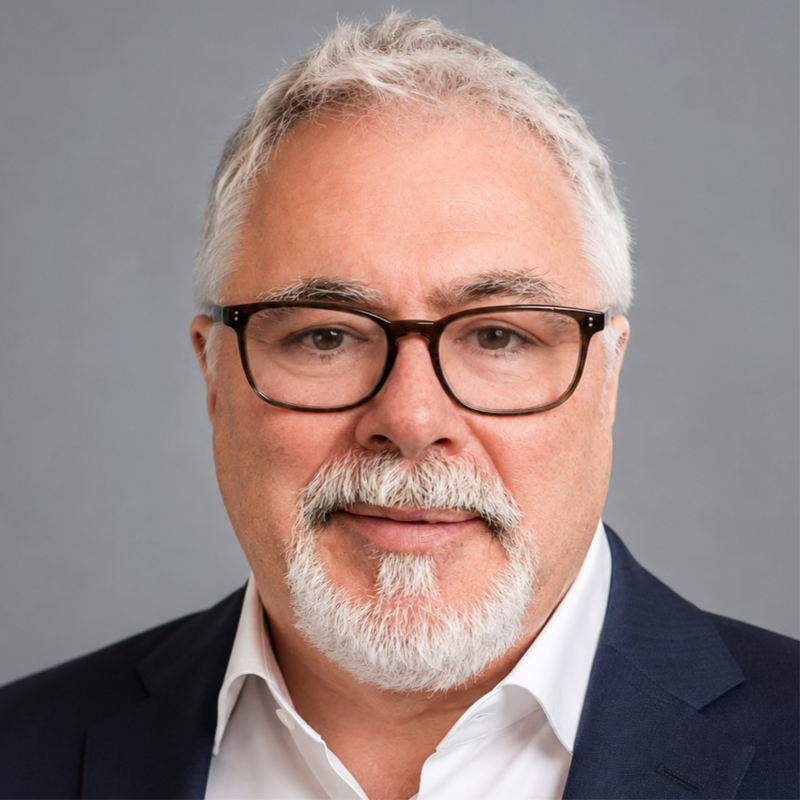
4 Questions to Mark Holdaway
Mark joined AGBC Munich in 2025.
Q1: Tell us about yourself – how long have you been in Munich, what brought you here and what industry are you in?
I originally moved to Germany in the early 1990s with my English wife after my employer at the time decided that Europe probably functioned better with fewer headquarters and more Germans involved in decision making. With a German VP and a consolidation programme underway, remaining in the UK was becoming a slightly theoretical option.
Unlike many colleagues who viewed Germany as a short-term posting, we arrived expecting to integrate and stay awhile. We had already started learning German, loved the countryside and the Alps, and thought the whole thing sounded like a great adventure. Of the original group who transferred over, I somehow ended up staying the longest. I finally left that employer after about 12 years in Germany, which probably says something about either my adaptability or my resistance to change.
Professionally, I’ve spent most of my career in the semiconductor and deep-tech industry, particularly around analog and mixed-signal electronics, automotive systems, and technical communication. These days I spend a lot of time thinking about complexity, communication, systems, and why modern organisations can possess infinite tooling yet still leave humans quietly confused.
Q2: How did you learn about AGBC, what was your reason for becoming a member and why would you recommend others to join?
I joined the AGBC roughly a year ago, at a point where I realised two things simultaneously: firstly, that many of my long-standing friends and colleagues had gradually dispersed back to the UK, the US, or elsewhere around the world; and secondly, that becoming an empty nester suddenly leaves suspicious amounts of free space in one’s calendar.
Approaching 60, I decided it was probably healthier to broaden my horizons rather than dedicating myself to becoming a grumpy middle-aged man shouting at news websites. I was looking for a mixed international community, intellectually stimulating discussion, and opportunities to contribute rather than simply consume.
I’ve also been genuinely grateful for the friendliness and opportunities Germany has given me over the last 33 years, so volunteering some time back into a community felt appropriate.
What I particularly appreciate about the AGBC is that conversations tend to be broader than pure business networking. There’s curiosity, experience, humour, and a willingness to discuss the bigger societal questions affecting all of us today. In an era increasingly dominated by social media noise and shrinking attention spans, that feels surprisingly valuable and energizing.
Q3: If you could choose one of the next AGBC event topics, what would it be?
I’d love to see more topic-driven dialogue around the issues many of us are genuinely struggling to resolve today.
For example:
- How do we maintain healthy communities and workplaces in an age of cognitive overload?
- Why does modern work often feel more fragmented despite all our digital tools?
- What happens when leadership becomes overly performative and society is still expectant of “heroes” stepping forward rather than accepting shared responsibility?
- How do we keep meaningful human connection alive in increasingly online lives?
I think many organisations suffer not from lack of intelligence, but from overload, fragmentation, and loss of shared meaning. We’ve become very good at creating systems and very poor at protecting attention.
That’s partly why I proposed the AGBC Thought Leadership Library initiative. I think experienced people still have an enormous amount of practical wisdom worth sharing, particularly across generations and industries.
Q4: What is your favorite spot/activity in Munich (or surroundings) and why?
One of the great joys of Munich is that you can work in a major international business centre yet be deep in nature surprisingly quickly. I live only about 16 km from the city centre, but the area still feels wonderfully close to genuine countryside.
As a result, I spend a lot of time walking and cycling through the Forstenrieder forest. I’m a huge believer in what the Japanese call Shinrin-yoku, though I still struggle to pronounce it convincingly. After more than 20 years exploring that forest, I still haven’t tired of it. Either the forest is extraordinarily large or my sense of direction remains adrift.
Beyond Munich itself, I never tire of the lakes and foothills south of the city. Places like Königssee, Spitzingsee and Walchensee still feel extraordinary to me even after decades here. And I’ll admit that the combination of a long Bavarian walk followed by a visit to the Brauhaus Tegernsee remains one of life’s more convincing arguments for staying in Germany.
The sheer diversity of beautiful places within easy reach of Munich is remarkable. I sometimes think Bavaria quietly spoils people without them fully noticing it.
Thank you, Mark!
LinkedIn profile